


Before You Commission Anything, Decide What Should Change
ENYEMAKA team ·
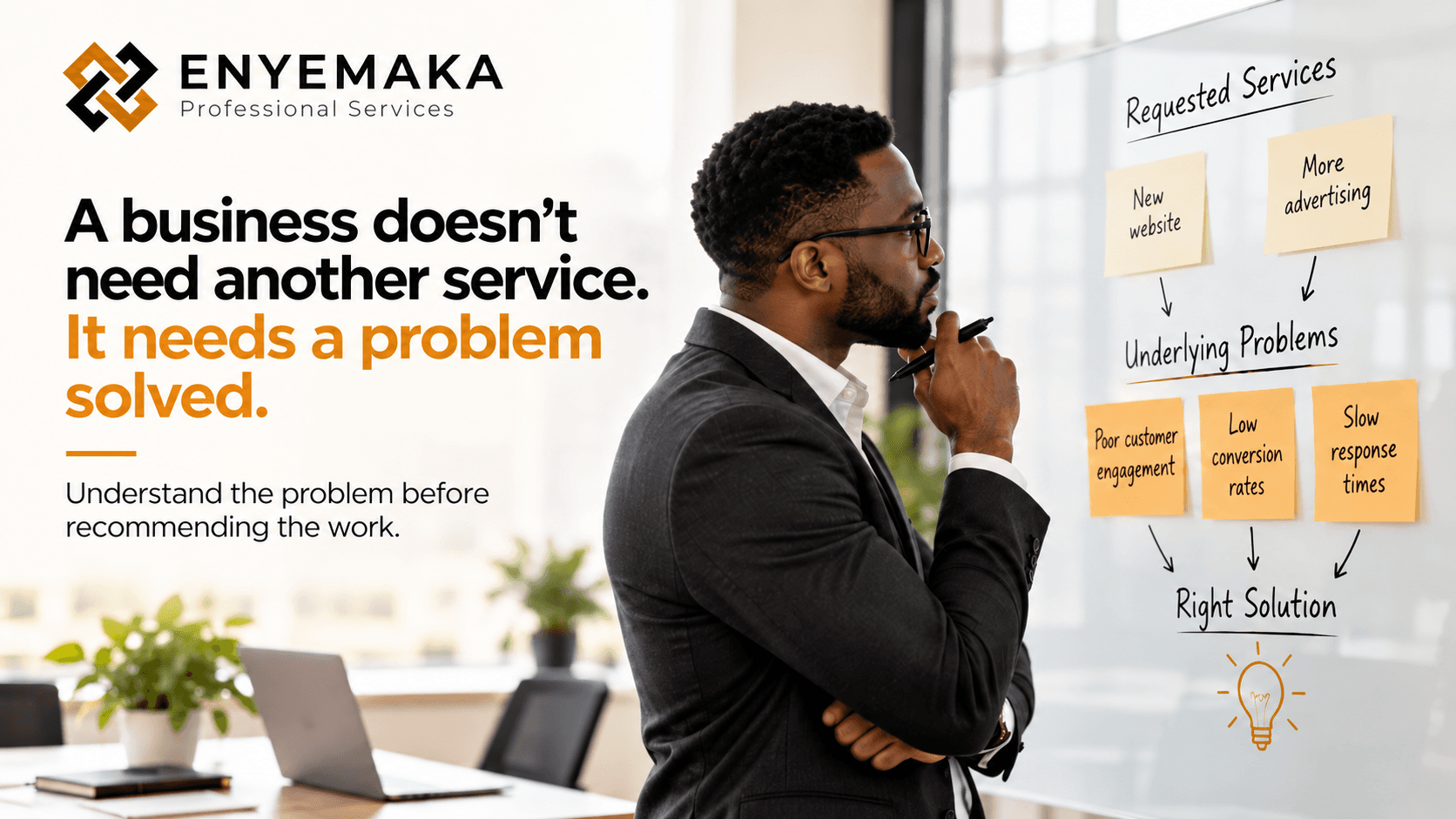
Nobody wakes up wanting a website.
They want more enquiries. Faster decisions. Fewer complaints. Steadier cash. The website, the dashboard or the campaign is just the route they've picked to get there.
That sounds obvious, but most project briefs don't start there. They start with the thing to be bought: "We need a new website." "We need a dashboard." "We need to run some ads." And once the brief starts with the thing, the most important question gets skipped: what should be different afterwards?
The vehicle and the destination
A useful way to think about any outside project is to separate the vehicle from the destination.
- The vehicle is the service: a website, an app, a brand refresh, a set of reports, a social media campaign.
- The destination is the result: what will be true in your business once the work is done.
You can only judge a vehicle by whether it gets you to the destination. A beautiful website that brings in no more enquiries than the old one isn't a success, however good it looks. A plain one that doubles your enquiries is.
Why briefs start with the vehicle
There are understandable reasons for this.
- The vehicle is easy to picture. You can point at a competitor's website. It's much harder to point at "steadier cash".
- Someone suggested it. A supplier, a friend or a staff member said, "You need an app." It stuck.
- It feels like action. Buying something feels like progress. Asking "what exactly is the problem?" can feel like delay.
None of this is foolish. But it means the project begins without a clear way to tell whether it worked.
What it costs you
When a brief names the vehicle but not the destination, a few things tend to go wrong.
- You get exactly what you asked for. The supplier builds the website you described. If the real problem was slow replies to enquiries, the new website won't fix it.
- You can't compare quotes properly. One supplier quotes for five pages, another for online booking and training. Without a clear outcome, you can't tell which one actually solves your problem. You end up comparing prices instead.
- The scope keeps growing. Without a destination, every new idea seems relevant. "While we're at it, can we add..." becomes a habit.
- Nobody can say whether it worked. Six months later, the project is "done", but no one can point to what improved.
The one-sentence test
Before you brief anyone, try finishing this sentence:
"This is worth paying for because, afterwards, ____ will be true."
The blank should describe something you could check. Not a feeling, and not the vehicle itself.
Here's what weak and strong answers look like:
- Weak: "We'll have a modern website." Stronger: "Most of our enquiries will come through the website with the details we need, instead of through scattered phone calls."
- Weak: "We'll have a dashboard." Stronger: "Every Monday, the operations manager will know which branch missed its sales target last week, without asking anyone."
- Weak: "We'll be more active on social media." Stronger: "Office administrators planning events will understand our meeting package well enough to book without five rounds of questions."
The stronger versions do something the weak ones don't. They tell the supplier what success looks like, and they tell you how to judge the work when it's delivered.
When the sentence is hard to write
Sometimes you'll sit with that sentence and struggle to fill the blank. That isn't a failure. It's useful information: the brief isn't ready yet.
A few things usually help:
- Talk to the people closest to customers. Front-desk staff, sales staff and whoever answers the phone often know exactly where things go wrong.
- Look back, not forward. What actually caused problems over the last three months? Lost customers, missed payments, complaints, wasted staff time?
- Ask what happens if you do nothing. If the honest answer is "not much", the project may not be urgent.
And sometimes the sentence reveals that you don't need the project at all. If the real problem is that nobody replies to enquiries quickly, a new website won't help. A named person and a reply-time target might.
From one sentence to a usable brief
Once you have the sentence, the rest of the brief becomes much easier to write. A short, useful brief covers:
- The outcome: your finished sentence.
- How you'll know: what you'll look at to check it, and roughly when.
- Who it's for: the customers or staff who'll use what's being built.
- Constraints: budget range, deadline, and anything that must stay the same.
- What's out of scope: things you've deliberately decided not to do this time.
- Who decides: the person who'll approve the work and sign it off.
That fits on one page. It gives any supplier, including us, enough to propose the right solution instead of just the one you named.
The outcome might change what you buy
This is the part people don't expect. When you start from the destination, the vehicle sometimes changes.
A business that came in asking for a new website might end up with a better enquiry form and a clear reply process. A team asking for a dashboard might first need someone to agree on which three numbers matter. That's not upselling or downselling. It's matching the work to the problem.
Before your next project
Write the sentence. If it's easy, you're ready to brief. If it's hard, spend a little more time on it before you spend money.
What's one result your next project must achieve?
If you'd like help turning that result into a clear brief, share it with us here.